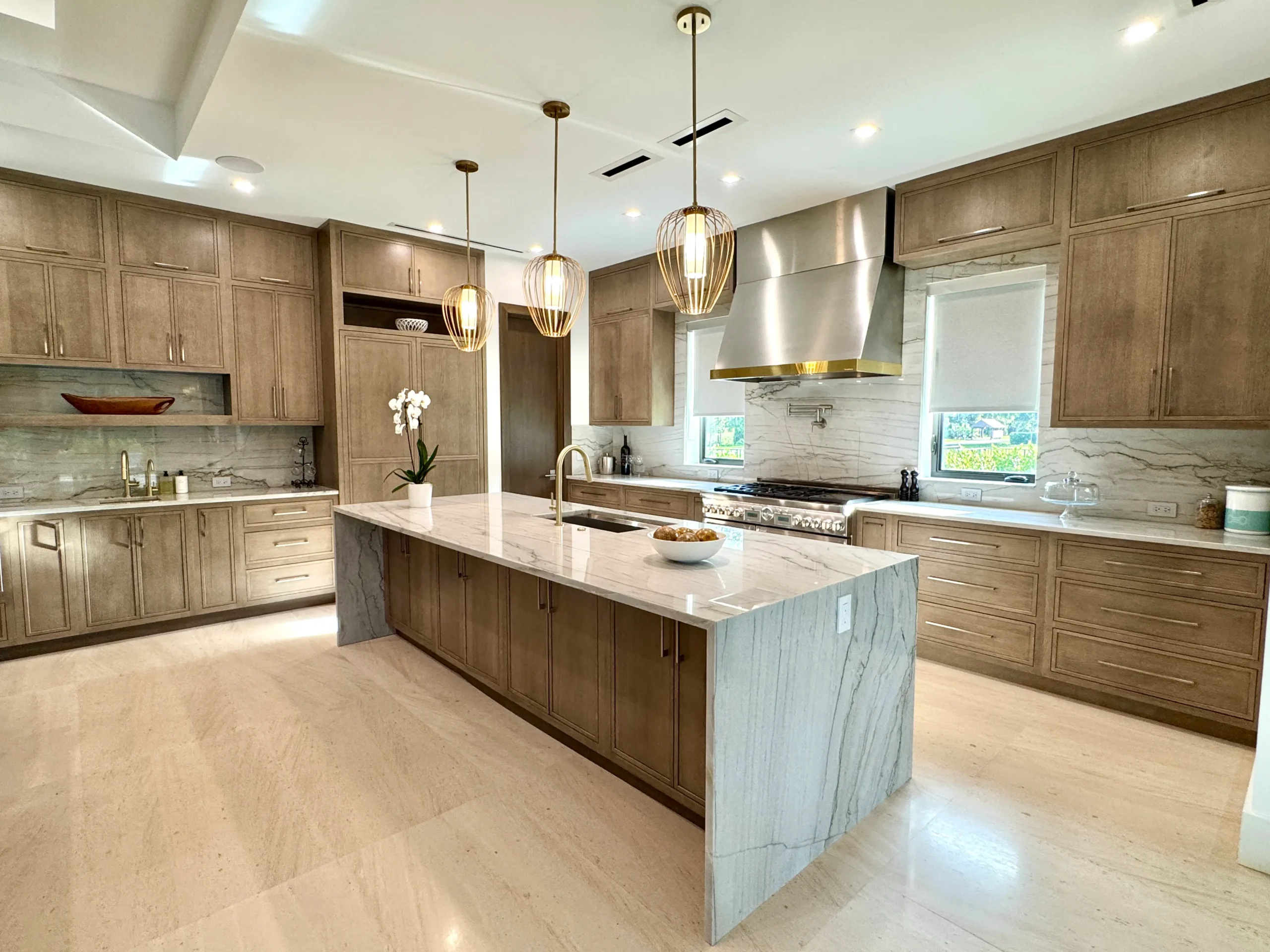
Two stones. Both natural. Both beautiful. But they perform very differently in a working kitchen.
If you’re choosing countertops for a home in Jupiter, this is probably the comparison you’re weighing. Marble and quartzite are the two most popular natural stone countertops in luxury kitchens across Palm Beach County. They look similar at first glance. They are not similar where it counts.
Here’s what you need to know before you choose.
Appearance
Marble has a warmth and softness that’s hard to copy. The veining is fluid, organic, and unmistakable. Calacatta and Statuario marbles have defined luxury kitchens for centuries. There’s a reason they’re still the reference point.
Quartzite offers similar visual depth with more variation. Some quartzites mirror marble’s veining so closely that even experienced designers need to look twice. Others have dramatic movement, translucency, or color that marble can’t match. Taj Mahal, Sea Pearl, and Cristallo quartzites are popular in Jupiter kitchens for exactly this reason.
Both stones are genuinely unique. No two slabs are identical. That’s one of the main reasons homeowners choose natural stone over manufactured surfaces.
Durability
This is where the two stones split.
Marble is a metamorphic limestone. It’s relatively soft on the stone hardness scale. It etches when exposed to acidic substances like lemon juice, wine, vinegar, or tomato sauce. Those etch marks appear as dull spots on a polished surface. They’re not stains. They’re chemical reactions with the stone itself.
Quartzite is a metamorphic sandstone. It’s much harder than marble. Most quartzites resist scratching and etching far better. You can squeeze a lemon on most quartzite surfaces without leaving a mark.
For a kitchen that sees heavy daily use, quartzite is the more forgiving choice.
Maintenance
Marble requires steady attention. Sealing every 6 to 12 months. Wiping up acidic spills promptly. Using cutting boards religiously. Accepting that the surface will develop a patina over time.
Some homeowners love that patina. It gives marble a lived-in quality that feels real in a home that’s actually used. Others find it frustrating. Neither reaction is wrong. It’s a matter of what you expect from your kitchen surfaces.
Quartzite needs less daily vigilance. It still needs periodic sealing, but it’s more forgiving of the things that happen in a real kitchen. A glass of red wine sits for an hour. A lemon rolls off the cutting board. Quartzite handles these moments without consequence.
Heat Resistance
Both stones handle heat well. You can set a hot pan on either surface without damage in most cases. However, extreme or prolonged heat can cause thermal shock in any natural stone. We always recommend using trivets as a precaution. Not because the stone can’t handle heat, but because protecting the surface costs nothing and prevention is easier than repair.
Cost
Pricing depends on the specific slab, its origin, rarity, and availability. Some exotic quartzites cost more per square foot than premium marbles. Some imported marbles cost more than common quartzites.
The installed cost also includes fabrication, edge profiling, and cutouts for sinks and cooktops. As part of our countertop services, we help you compare total project cost during the selection process so there are no surprises.
Which One Is Right for Your Kitchen?
If you want a timeless, elegant surface and you’re willing to maintain it, marble rewards that commitment. If you want natural stone beauty with less maintenance, quartzite is the stronger practical choice.
Both work beautifully in Jupiter kitchens. Both pair well with custom cabinetry. Both hold their value in high-end homes.
The best way to decide is to see them in person. We accompany you through slab selection as part of your kitchen remodeling or bathroom remodeling project. You’ll see the actual slabs, compare them side by side, and choose with confidence.
Frequently Asked Questions
Is quartzite more durable than marble?
Yes. Quartzite is much harder than marble and resists scratching and etching better. Marble is a softer stone that reacts to acidic substances like lemon juice, wine, and vinegar. Quartzite handles these exposures without damage in most cases.
Does marble stain easily?
Marble is more porous than quartzite and can stain if spills aren’t cleaned promptly. Regular sealing reduces the risk, but marble does require more attentive maintenance than quartzite. Many homeowners consider the gradual patina part of marble’s character.
Which is more expensive, marble or quartzite?
Pricing varies widely by specific slab, origin, and rarity. Some exotic quartzites cost more than common marbles. Some premium marbles cost more than standard quartzites. We help you compare options within your budget during slab selection.
Can quartzite be used in bathrooms?
Yes. Quartzite works well in bathroom uses including vanity tops, shower surrounds, and tub decks. Its hardness and resistance to moisture make it a strong choice for wet environments.
Compare Your Options in Person
Contact Palmhouse Design & Build to schedule a slab selection visit. We serve Jupiter FL and luxury residences throughout Palm Beach County.
Call 561-831-4170